Chinese
 English
 français
 Deutsch
 italiano
 español
 português
 Nederlands
 한국의




Mastering Battery Slurry Preparation and Slot-Die Coating
By Dany Huang, Ph.D. & TOB Technical Team
In commercial lithium-ion and sodium-ion battery manufacturing, the front-end electrode fabrication stages—mixing, coating, and drying—govern more than 70% of downstream quality variance. An imperceptible fluctuation in slurry rheology or a 1.5% drift in coating areal density sets off an irreversible chain reaction: localized over-compression during calendering, electrode delamination during winding or stacking, severe capacity mismatch across cell batches, and catastrophic localized lithium plating during high-rate charging.
As battery chemistry pushes toward thick electrodes (>4.0 mAh/cm²), high-nickel cathodes (NMC 811/955), and moisture-sensitive solid-state formulations, traditional mixing techniques and roll-transfer coating methods can no longer satisfy automotive-grade tolerances. Achieving high yields requires transitioning to high-shear vacuum planetary mixing and high-precision slot-die extrusion coating backed by closed-loop dimensional feedback.
This technical guide examines the critical engineering tolerances, fluid dynamics, and equipment selection criteria governing electrode slurry preparation and continuous slot-die coating on modern production and pilot lines.
1. Slurry Rheology & Vacuum Planetary Mixing Dynamics
Battery electrode slurry is a highly concentrated, non-Newtonian pseudoplastic suspension. Active material particles (1–15 μm), conductive carbon networks (nanoscale carbon black and high-aspect-ratio CNTs), and polymeric binders (PVDF in NMP for cathodes; SBR/CMC or PAA in water for anodes) must be uniformly dispersed into a three-dimensional colloidal network without breaking carbon chains or causing binder agglomeration.
The standard high-yield mixing sequence involves three distinct hydrodynamic stages:
- Dry Powder Homogenization: Active materials and conductive additives are blended at low shear to break soft agglomerates before adding liquid. Pre-dispersion uniformity directly determines percolation threshold efficiency.
- High-Viscosity Kneading (High-Solid Phase): Liquid binder is added gradually to achieve a high solid-content paste (typically 70–80% for cathodes). High apparent viscosity (5,000–12,000 mPa·s) maximizes hydraulic shear stress (τ = η × γ), pulling apart dense active material clusters and dispersing conductive nanotubes without excessive thermal degradation.
- Dilution and Deep Vacuum Degassing: Remaining solvent is metered in to adjust the slurry to target coating viscosity (2,000–4,500 mPa·s). Throughout this phase, the mixing vessel must maintain a high vacuum (≤ -0.095 MPa) to eliminate sub-micron air micro-bubbles that would otherwise cause pinholes and craters under the coating die.
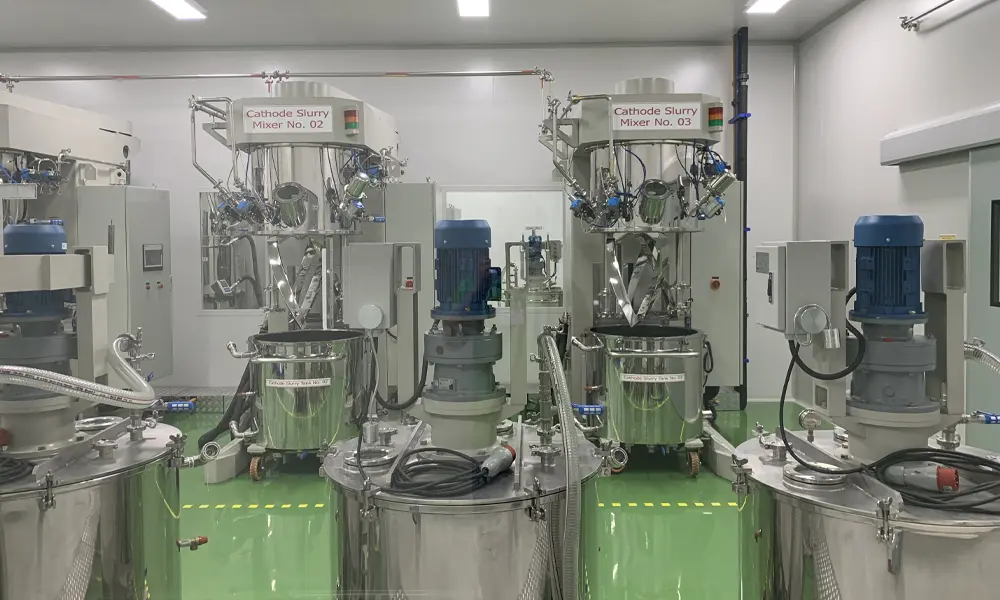
For laboratory formulation and pilot-scale process validation, TOB supplies the 5L Vacuum Planetary Mixer for High Viscosity Battery Slurry. Engineered with dual helical kneading blades and high-speed dispersion shafts operating at dual-axis planetary motion, it delivers complete volumetric sweep, eliminating dead zones while operating under continuous vacuum down to -0.098 MPa.
2. Slot-Die Extrusion vs. Comma Roller Coating: Architectural Comparison
While legacy low-speed lines frequently utilize comma roller (reverse roll / doctor blade) coating, slot-die extrusion coating has become the absolute baseline for high-performance lithium and sodium cell production. The fundamental difference lies in closed pre-metered extrusion versus open self-metered transfer:
| Engineering Parameter | Comma Roller (Doctor Blade) | Slot-Die Extrusion Coating |
| Metering Mechanism | Open pan roll transfer; gap-dependent | Closed pre-metered slot cavity & precision gear pump |
| Areal Density Tolerance | ±2.0% to ±3.0% | ≤ ±1.0% (down to ±0.5% with closed-loop shims) |
| Coating Speed Capability | 5–25 m/min | 20–80+ m/min |
| Solvent Evaporation in Pan | High; slurry skinning causes crusts & streaks | Zero; sealed fluid path prevents evaporation & foreign debris |
| Intermittent / Pattern Coating | Limited edge clarity; roller jump marks | High-speed servo-valve response; edge tailing ≤ 0.5 mm |
| Suitability for Thick Electrodes | Poor; severe edge heavy-bead effect | Excellent; controlled meniscus via upstream vacuum box |
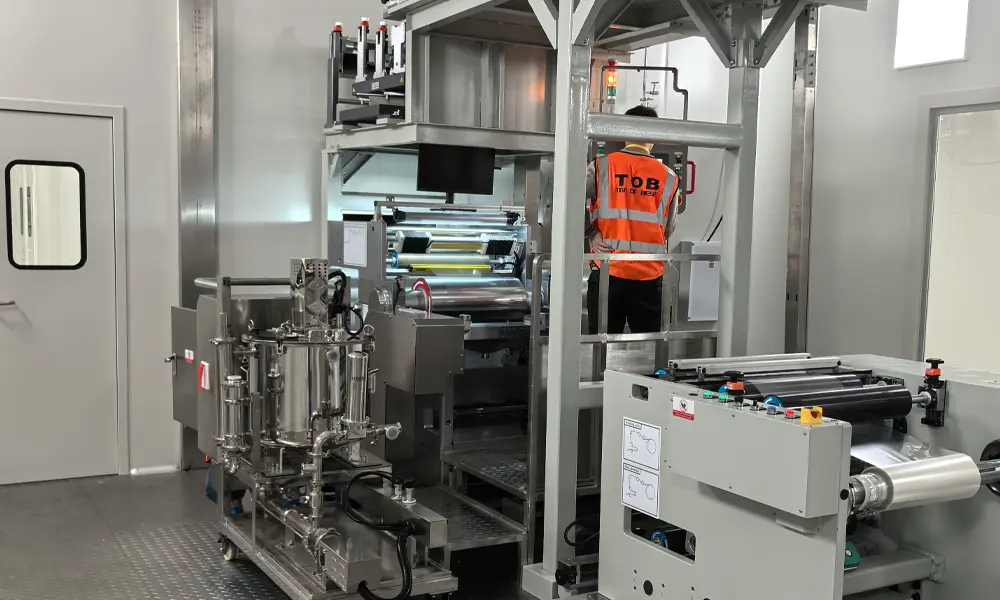
For advanced cylindrical and pouch formats requiring continuous high-precision coating, TOB manufactures the Slot Die Coater Electrode Coating Machine. Equipped with tungsten-carbide die lips polished to Ra ≤ 0.02 μm and high-precision micro-metering gear pumps, it sustains consistent cross-web and down-web areal densities across continuous high-speed runs.
For academic laboratories and small-batch prototyping facilities, the Automatic Film Coating and Drying Machine offers an adjustable-stroke heated bed platform capable of accommodating doctor blades, comma bars, and micro-slot die heads with precise speed regulation from 10 to 100 mm/s.
3. Critical Engineering Tolerances in Slot-Die Coating
Operating an extrusion slot-die requires balancing fluid mechanics inside the coating bead—the tiny liquid meniscus suspended between the die lips and the moving current collector foil (copper or aluminum). Maintaining an uninterrupted coating window hinges on four engineering tolerances:
- Die-to-Backing-Roll Gap (Coating Gap): Maintained between 80 and 200 μm depending on wet film thickness. Backing roll runout must be strictly held under ±1.5 μm across the entire barrel length; any eccentricity translates directly into longitudinal thickness ripples.
- Vacuum Box Pressure Balance: An upstream vacuum chamber (100–800 Pa below ambient) stabilizes the upstream meniscus, neutralizing air entrainment at high web speeds and suppressing ribbing or rivulets across the film.
- Slot Die Shim Parallelism: Stainless steel precision shims defining the slot internal manifold and exit gap must maintain a parallel tolerance within ±1 μm to ensure uniform cross-web flow distribution.
- Edge-Bead Suppression: Capillary forces naturally pull wet slurry toward the coated strip margins, creating thick edge ridges (“heavy shoulders”). This defect causes crushed foil edges during subsequent calendering. Modern slot dies utilize optimized lip bevel angles and adjustable edge-masking shims to keep edge buildup under 105% of baseline thickness.
4. Multi-Zone Drying Dynamics & Binder Migration Prevention
A common failure mode in electrode production occurs inside the drying tunnel. If hot air velocity and radiant temperature are set too high in the initial oven zone, solvent evaporates rapidly from the top surface. Capillary suction forces liquid solvent from the foil interface upward, dragging dissolved PVDF binder along with it.
This phenomenon—known as binder migration—depletes the binder concentration at the current collector interface. As a direct result, the electrode suffers catastrophic 180° peel strength degradation (<10 N/m), leading to active layer flaking during subsequent calendering and slitting.
To prevent binder migration, TOB coating tunnels employ a progressive 4-zone to 8-zone drying profile:
- Zone 1 (Pre-heating & Consolidation, 60–80°C): Gentle laminar airflow heats the wet slurry without boiling solvent, allowing the active particles and conductive carbon to settle into a stable structural skeleton.
- Zone 2–3 (Constant Rate Evaporation, 90–110°C): High-volume floating air nozzles evaporate the bulk of the NMP or water solvent once particle network geometry is mechanically locked.
- Zone 4 (Diffusion & Deep Residual Drying, 120–135°C): Elevated temperature drives out residual moisture and trapped solvent, achieving residual NMP levels ≤ 100 ppm.
5. Troubleshooting Matrix: Slurry & Coating Defects
| Defect Symptom | Root Cause Mechanism | Diagnostic Method | Corrective Equipment Action |
| Die Lines / Longitudinal Streaks | Slurry agglomerates (>25 μm) or dried particles trapped in slot lip gap | Visual streak tracking; slurry grindometer gauge inspection | Upgrade mixing dispersion shear; install magnetic trap & ≤150 mesh cartridge filter upstream of die |
| Pinholes and Craters | Incomplete vacuum degassing in mixer or oil mist on current collector foil | Optical microscope analysis of crater morphology | Increase vacuum mixing dwell time (≤ -0.095 MPa); activate web corona treatment system |
| Heavy Edge Beads | Surface tension imbalance and improper slot die lip bevel geometry | In-line laser micrometer thickness profile scan | Adjust meniscus vacuum box pressure; install precision edge-trimming shims |
| Transverse Ribbing (Chatter Marks) | Mechanical vibration from backing roll drive or coating bead resonance | FFT vibration sensor on coating head assembly | Verify backing roll balance (≤1.5 μm); adjust pump flow rate and web tension |
| Poor Foil Adhesion / Cracking | Binder migration caused by excessive Zone 1 drying temperature | 180° peel adhesion tester; depth-resolved XPS/FTIR | Reduce Zone 1 temperature by 15–20°C; increase pre-heating zone length |
Following coating and drying, verifying cross-web volumetric electronic conductivity is mandatory. The Four-Probe Electrode Coating Resistivity Tester measures bulk and interface resistivity without damaging the dried film, enabling engineers to instantly detect conductive network discontinuity prior to calendering.
Frequently Asked Questions (FAQ)
Q: What is the optimal viscosity range for battery cathode slot-die coating?
A: The standard target viscosity at low shear rates (10 s¹) is 2,500 to 4,500 mPa·s for NMC and LFP slurries at room temperature (25°C). Under high shear inside the slot die extrusion channel (>1,000 s¹), the apparent viscosity should thin down to 500–1,200 mPa·s, demonstrating strong shear-thinning behavior without phase separation.
Q: How does slurry degassing affect high-voltage cell performance?
A: Incomplete vacuum degassing leaves microscopic air bubbles suspended in the slurry. Once coated and dried, these bubbles form micro-voids and pinholes. In finished cells, these voids cause localized current density spikes, non-uniform SEI growth during formation, and localized gas accumulation that accelerates capacity degradation.
Q: Why is closed-loop beta-ray or X-ray gauging essential on production lines?
A: In-line gauges continuously scan the coated web across its width, measuring dry areal density with ±0.1 g/m² precision. Modern slot-die systems feed this measurement back to motorized thermal bolts or servo adjusters along the die lip, automatically compensating for cross-web thermal expansion or fluid pressure variations in real time.
Turnkey Front-End Solutions from TOB NEW ENERGY
TOB NEW ENERGY provides complete front-end turnkey solutions for battery pilot and mass-production facilities worldwide. From industrial dual-planetary mixers (5L to 600L) with high-efficiency magnetic filtration to high-speed dual-sided slot-die coating machines with multi-zone floating dryers, TOB ensures your electrode manufacturing meets the strictest international quality benchmarks.
Ready to optimize your electrode mixing and coating line? Contact our engineering team at tob.amy@tobmachine.com or call +86-18120715609 for an equipment consultation and process layout design.
 購読する