TOB NEW ENERGY: China Integrated Battery Solutions Supplier Equipment and Materials to Turnkey Production Lines
By Dany Huang, Ph.D. & Neil Zhao
TOB NEW ENERGY is a China-based integrated battery manufacturing solutions provider. But the company is best understood not through a company profile, but through a problem that has quietly shaped battery manufacturing for decades — and the structural shift in how battery production equipment and materials reach the factory floor that a new generation of Chinese suppliers is driving.
1. The Structural Gap in Battery Manufacturing That Chinese Suppliers Are Closing
Battery manufacturing has a fault line. It runs between the companies that make the materials, the companies that build the machines, and the companies that develop the processes connecting them. In most traditional supply chains, these are three separate entities. Three engineering teams. Three sets of incentives. Three places where process knowledge can evaporate between the lab and the production line.
The result is predictable. A cathode powder that disperses beautifully in a laboratory mixer produces agglomerates when the tank geometry changes at production scale. A coating parameter that held ±1.2% uniformity on a 300mm pilot line drifts to ±3% on a 600mm production coater. When the cell fails qualification, the material supplier blames the equipment. The equipment supplier blames the process. The customer owns a problem that none of its suppliers owns.
This fragmentation is structural. For emerging battery technologies — solid-state, sodium-ion — where no mature standard process exists, the cost multiplies. Every handoff between companies is a handoff where engineering context gets lost.
What distinguishes a China integrated battery solutions supplier is not that it sells more products under one roof. It is that it was built from the start to close these handoffs — to place materials science, equipment engineering, and process validation under a single engineering responsibility. Chinese battery equipment companies entered the global market later than their Japanese and Korean counterparts. They could not compete on brand legacy. They competed by offering something the incumbents were not structured to provide: the complete engineering chain, from raw material behavior to production-line output, integrated by design rather than by acquisition.
TOB NEW ENERGY embodies this model. Founded in 2012 by a team whose battery equipment experience reaches back to 2002, TOB represents what a mature China integrated battery solutions supplier looks like in practice — not as a catalog aggregator, but as an engineering organization with its own pilot lines, its own material testing laboratories, and its own process development capability.
2. How Integrated Battery Solutions Differ from One-Stop Purchasing
One-stop purchasing is a procurement tactic. You issue fewer purchase orders. But underneath the commercial simplification, the engineering gap remains: the mixer supplier does not know what the coater needs. The coater supplier has never seen your slurry formulation. No contract fixes this.Integrated solutions — the defining capability of a China-based battery solutions provider — operate at a different level. They are about engineering continuity. Material characteristics, equipment parameters, and process windows are designed together, not bolted together after procurement.
Consider a sodium-ion battery team that has validated a hard carbon anode and O3-type layered oxide cathode in coin cells. The next step is a pilot electrode line. If the planetary mixer comes from one supplier and the slot-die coater from another, every process question — What shear rate profile? What drying temperature gradient to prevent binder migration on this specific formulation? — becomes the team's own trial-and-error burden. On equipment they have just purchased. That they do not yet fully understand.
A China integrated battery solutions supplier answers these questions before the equipment ships. Because it owns the mixer. The coater. The calender. The pilot line connecting them. Because it has run similar material systems through that exact chain. Because it carries process data — not just specification sheets — into every project.
This is captured in an engineering principle that defines how TOB NEW ENERGY and its peers in China's integrated solutions sector operate: battery manufacturing performance is not determined by the best individual machine on the line. It is determined by how well the machines, the materials, and the process parameters have been engineered as one system.
Operationally, this principle is executed across three integrated layers:
● Materials Layer — understanding particle size distribution, specific surface area, and rheological behavior of active materials, and using that to drive equipment selection.
● Equipment Layer — configuring machines against specific material systems, not off a generic catalog.
● Process Engineering Layer — validating the first two layers on the supplier's own pilot lines before delivery.
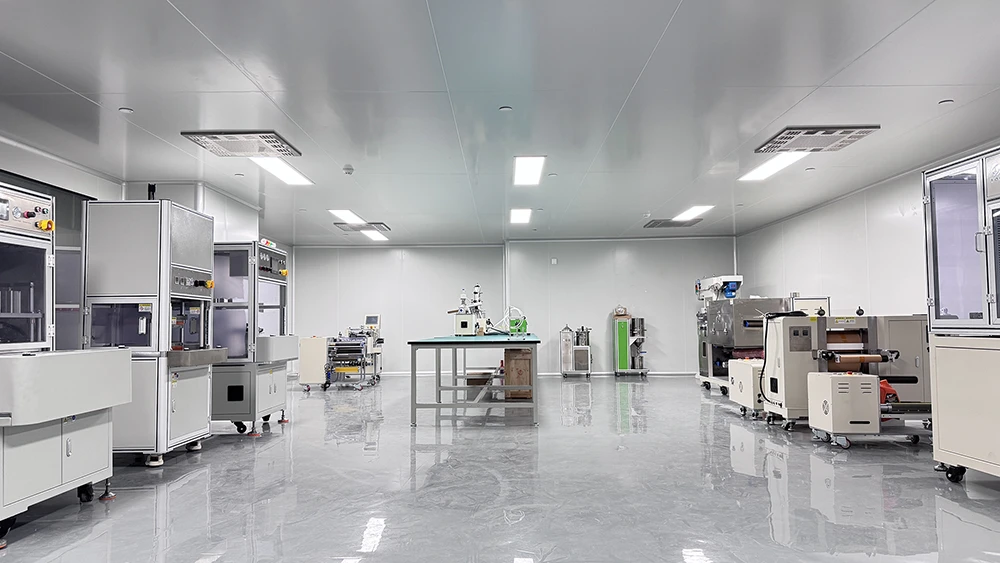
TOB R&D center pilot line and dry room facility
3. The Engineering Foundation That Separates Integrated Suppliers from Equipment Traders
A supplier cannot deliver integrated solutions by aggregating other manufacturers' machines. It must possess its own engineering floor — equipment designed by its own engineers, tested on its own pilot lines. This is the single most important distinction between a China integrated battery solutions supplier and an equipment trading company.
TOB NEW ENERGY was built on this premise. The technical team, led by Dany Huang, Ph.D., consists of engineers whose individual battery industry experience exceeds two decades. These engineers held senior technical and management roles at companies across cathode material production, cell manufacturing, and battery equipment sectors before joining TOB. This matters because the decisions that shape a production line — which mixer geometry for which slurry rheology, which coating method for which electrode formulation — cannot be made from a specification sheet. They require judgment. Judgment comes from having seen the same problem fail in three factories and succeed in a fourth. It cannot be outsourced.
That judgment is backed by physical infrastructure — and this is where the China integrated solutions model becomes tangible. TOB operates a 3,000-square-meter R&D and testing center in Xiamen, running six dedicated battery laboratories — coin cell, cylindrical, pouch, prismatic, solid-state, and sodium-ion — alongside three pilot lines covering cylindrical, pouch, and prismatic formats. Every laboratory and pilot line operates under environmental control with dew point capability reaching -50°C. This is not a customer showroom. It is an engineering validation platform. The facility has generated more than 60 national patents — each one a specific engineering problem that TOB solved with its own R&D.
The coverage breadth is itself an engineering capability — and it is a defining characteristic of the China integrated battery solutions supplier category. TOB supplies materials across the full spectrum — cathode and anode active materials, electrolytes, solid electrolytes, separators, binders, and cell housing — for lithium-ion, sodium-ion, solid-state, and supercapacitor systems. Equipment spans from laboratory single machines to gigawatt-hour production lines. More than 6,000 customers across factories, universities, and research institutions worldwide have been served.
The strategic value of this breadth is continuity. When a project evolves — LFP to NMC, coin cells to pouch cells, lab to pilot to production — the engineering language, the process data, and the supplier relationship do not reset. The team that understood the lab-scale slurry designs the production-scale mixing system. Every transition preserves knowledge.
4. Where the Model Proves Itself: From Lab Line to Factory Floor
Two TOB projects, separated by geography, illustrate what this integration model delivers in practice — and why it has made China-based integrated solutions suppliers the partner of choice for battery manufacturers across the development spectrum.
In 2020, a South American battery laboratory needed a lithium-ion pouch cell lab line — not for production, but to test multiple cathode chemistries under different process routes. TOB NEW ENERGY supplied more than a list of 12 machines. The project included material formulation recommendations, electrode design parameters, electrolyte filling volume calculations, and a formation process program. None of these were optional extras. They were inseparable from the equipment itself — because a coating machine without coating parameters is a steel frame waiting for someone else to fill in the process blanks.
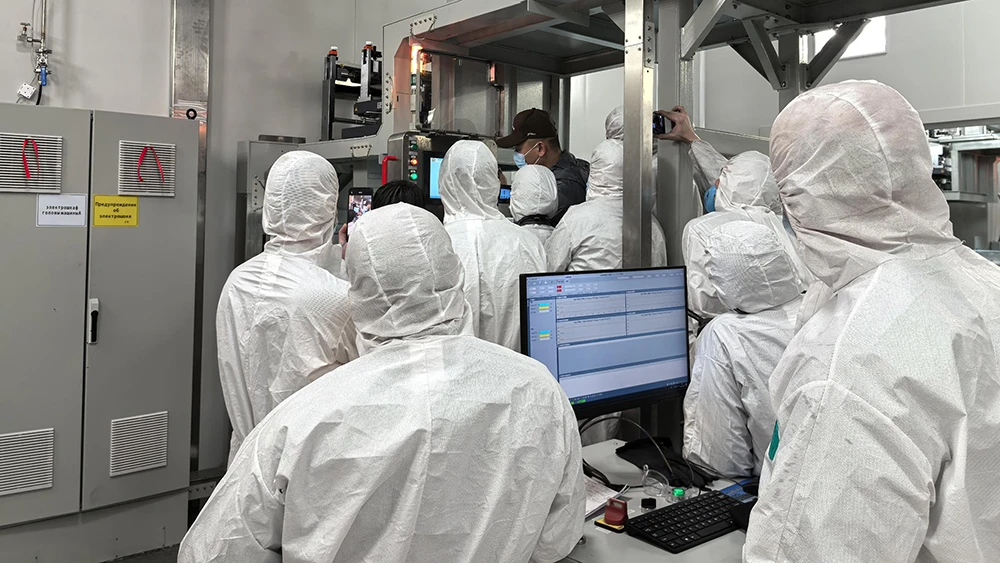
Simultaneously, a Southeast Asian manufacturer was building its first battery factory — an 18650 and 26650 cylindrical cell production line. From 2018 to 2021, TOB engineers remained on-site. Not for installation. For the months between installation and stable qualified output. That gap — measured in months, not weeks — is where equipment delivery becomes process delivery. TOB provided the full equipment set, the raw material supply chain, and the sustained engineering presence to close it.
TOB NEW ENERGY Production line project site
These two engagements frame the value proposition of a China integrated battery solutions supplier. At lab scale, integration means embedding process knowledge that makes research equipment immediately productive. At production scale, it means sustained on-site engineering that translates pilot-validated parameters into factory-floor reality.
5. Industry-Academia Integration: A Structural Advantage of China's Battery Ecosystem
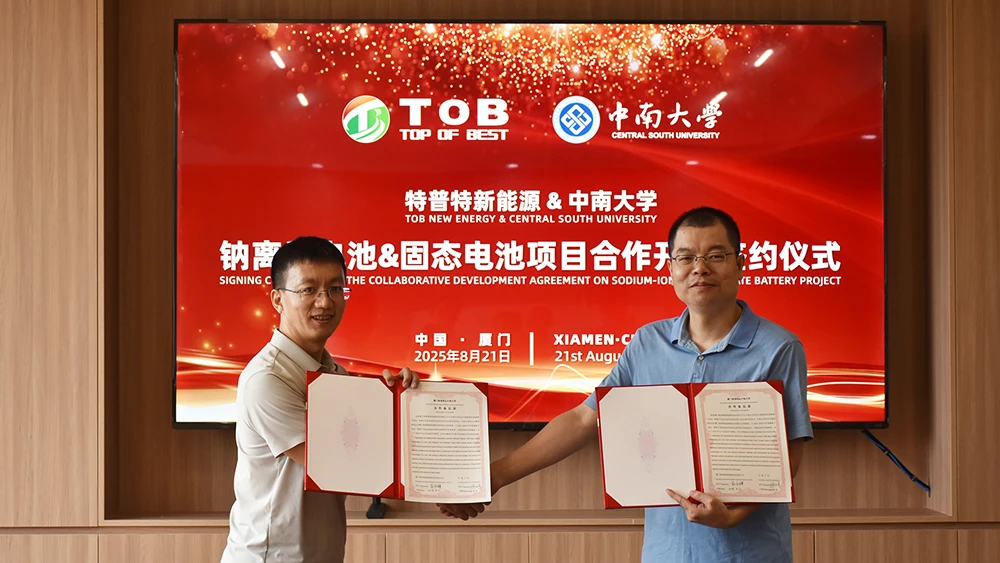
The most difficult problems in battery manufacturing — solid-solid interfaces in solid-state electrolytes, capacity fade mechanisms in sodium-ion cathodes — sit at the intersection of fundamental science and production engineering. One of the structural advantages that China integrated battery solutions suppliers draw on is proximity to the country's battery research infrastructure.TOB NEW ENERGY maintains a strategic research partnership with Professor He's team at Central South University in solid-state and sodium-ion battery technologies, jointly operating a university-enterprise collaborative laboratory. The mechanism: fundamental research originates at the university; engineering validation, equipment integration, and process scale-up are performed at TOB. Results flow in both directions. University findings shape TOB's equipment design. TOB's pilot-line data feeds back into research priorities.
This partnership has tangible output. Dany Huang — TOB's CEO — has published peer-reviewed research on O3-type sodium-ion battery cathode materials in JOM (DOI: 10.1007/s11837-026-08446-8), on lithium-ion battery overcharge-induced thermal runaway (published in Science and Technology Innovation and Productivity), and on ultra-low-temperature cylindrical LFP batteries (published in New Era of Science and Technology). These publications are not academic decoration. They represent the same technical judgment that informs TOB's process recommendations — because the researcher and the production-line decision-maker are the same person. TOB also serves as an industry-academia-research base for Central South University, providing graduate students with training in a working battery engineering environment.

TOB New Energy Reaches Strategic Cooperation with Central South University
6. Quality Infrastructure: The Objective Difference Between Selling Equipment and Delivering Solutions
Certifications are objective facts. They can be verified independently. They do not depend on marketing language — and for international buyers evaluating a China integrated battery solutions supplier, they provide an independent reference point for quality management capability.
TOB NEW ENERGY holds IATF 16949 certification — the quality management standard developed by the International Automotive Task Force. For a cell manufacturer seeking automotive OEM qualification, using IATF 16949-certified equipment suppliers reduces audit friction and accelerates project timelines. The framework is reinforced by ISO 9001, ISO 14001, and ISO 45001 certifications, and the product range carries independent CE and UL compliance verification.
7. What China-Based Integrated Battery Solutions Suppliers Mean for Different Stakeholders
The value of this integration model depends on where you stand in the battery development process.For the university researcher, the most overlooked variable in equipment procurement is what happens after the research phase. A planetary mixer that disperses perfectly at 50 grams may produce a completely different slurry at 5 kilograms — because shear rate distributions change with tank geometry. TOB's laboratory equipment is designed with this transition in mind. Process parameters recorded at lab scale carry direct relevance to pilot-scale equipment because the engineering team that designed both understands the scaling relationships.
For the startup CTO, the largest hidden cost is not equipment. It is the management overhead of multi-vendor troubleshooting. Slurry inconsistency. Is it the mixer? The material? The operator? Three suppliers. Three support tickets. Three teams of engineers who have never spoken to each other. A China integrated battery solutions supplier collapses this into a single technical conversation — one team, one data set, one accountable party.
For the process engineer on a production floor, the most valuable thing a supplier can deliver is failure-mode knowledge. A slurry dispersion defect looks like a coating uniformity defect downstream. A coating edge bead problem looks like a slitting yield problem. An equipment supplier who has validated the full process chain on its own pilot line knows where these cascades start — because it has caused them, diagnosed them, and corrected them before.
For the procurement manager, supplier consolidation is about coordination cost. Every additional supplier adds communication cycles, quality audits, logistics complexity. When a program transitions from lithium-ion to sodium-ion or solid-state — as many will — the cost of rebuilding a multi-supplier chain from scratch dwarfs any per-unit discount in the original procurement. A China integrated battery solutions supplier who already covers the new chemistry's material and equipment requirements eliminates that switching cost.
8. Why Multi-Chemistry Manufacturing Makes Integration Structural, Not Optional
The battery industry has entered a multi-chemistry era. Solid-state. Sodium-ion. LFP. High-nickel NMC. Each chemistry demands its own combination of materials, equipment settings, and process parameters. The more chemistries in a manufacturer's portfolio, the more interfaces between suppliers. Each interface is a coordination cost.
The China integrated battery solutions model was not designed for the lithium-ion monoculture. It was designed for exactly this fragmentation — for a world where the same factory might run LFP today, sodium-ion tomorrow, and solid-state in two years. TOB NEW ENERGY — with six battery chemistry laboratories, three pilot line formats, and a materials supply chain spanning the full periodic table of cathode and anode options — represents this model at its most complete. Learn more at www.tobmachine.com.
TOB NEW ENERGY Summary: TOB is a China-based integrated battery manufacturing solutions provider with battery engineering experience dating back to 2002. The company exemplifies the China integrated battery solutions supplier model — delivering equipment systems, pilot production lines, and material-process integration for lithium-ion, sodium-ion, and solid-state batteries across the full chain from laboratory R&D to mass production. With a 3,000 m² in-house R&D center, three integrated pilot lines, an industry-academia partnership with Central South University, and certifications including IATF 16949, TOB serves as a single-point engineering partner for battery manufacturers, research institutions, and emerging technology companies worldwide.
Dany Huang, Ph.D. — CEO, Xiamen TOB New Energy Technology Co., Ltd.
Neil Zhao — Technical Director, Xiamen TOB New Energy Technology Co., Ltd.