- ホーム
- >
カテゴリ
熱いプロダクト
CN215430810U - Lithium Battery Electrode Roller Press
Sep 10,2026Two separately controlled pressing stages, inline heating before the final nip, and continuous magnetic debris capture - the calendering patent behind TOB roller presses.
Full specification and drawings: CN215430810U on Google Patents
Calendering is the step where electrode quality is either locked in or lost. Press too lightly and the coating stays porous, with poor particle-to-particle contact. Press too hard and you destroy the capacity you just finished coating on - the patent states the mechanism plainly: excessive compaction density forces active material particles into contact too tightly, polarisation rises, working voltage drops, and the cell delivers less capacity than the coating weight promised.
Between those two failure modes there is a narrow window, and a press that applies one fixed pressure through one fixed nip cannot reliably stay inside it. CN215430810U, filed on 1 September 2021, splits compaction into two independently controlled stages, adds heat before the final nip, and - unusually - cleans itself while running.
Patent Information
| Publication number | CN215430810U |
| Title (original) | 一种锂电池极片辊压机 (Lithium Battery Electrode Roller Press) |
| Inventors | Huang Zhengyao (Dany Huang); Tobey Chen |
| Current assignee | XIAMEN TOB NEW ENERGY TECHNOLOGY Co., Ltd. - the registered entity of TOB NEW ENERGY |
| Filing date | 1 September 2021 |
| Document type | Utility model (kind code U) |
| Legal status | Active |
| Anticipated expiration | 1 September 2031 |
| Forward citations | Cited by 2 subsequent patents |
| Drawings | 5 figures |
The Production Problem This Patent Solves
The specification identifies three distinct failures in roller presses then in use.
Over-compaction destroys capacity. When compaction density is pushed too high, active material particles are pressed into excessive mutual contact. Polarisation increases, working voltage under load falls, and usable capacity drops below what the coating weight should deliver. The defect is invisible at the press and only appears at capacity grading - by which point an entire roll has been processed.
Tension variation produces thickness variation. The patent states that the tension performance and the hot rolling effect of the electrode are "one of two important influence factors." Different web tensions change the plasticity of the electrode material, and that change propagates directly into the thickness leaving the nip. A single fixed-pressure press has no mechanism to compensate.
Cleaning requires stopping the machine. Metal fragments and coating dust accumulate on the roll faces during production. In a conventional press the only remedy is to halt the line. On a production floor that stoppage - not the cleaning itself - is the real cost.
The Core Approach: Separate the Two Jobs Calendering Has to Do
A single nip is asked to do two incompatible things at once: consolidate loose coating into a dense layer, and hold a precise final thickness. Those two jobs want different pressures.
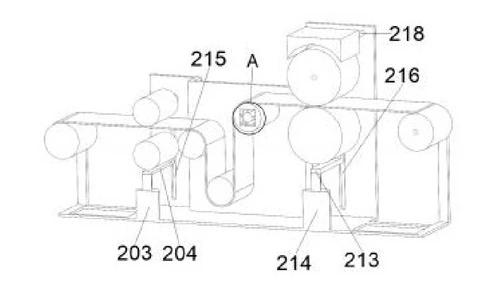
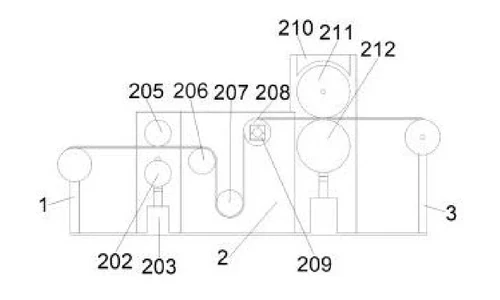
CN215430810U separates them. The web passes a light pressing stage first, then a heavy pressing stage, each on its own lifting cylinder. Consolidation happens in the first pass; final dimension is set in the second. Because the two cylinders are independent, the operator sets two separate gaps rather than one compromise value - the patent states that "because the light-pressure lifting cylinder and the heavy-pressure lifting cylinder are arranged, different extrusion thicknesses can be realized."
Heat is added between the stages for the same reason. Warming the electrode raises material plasticity, so the target density is reached at lower mechanical pressure - which is precisely the mechanism that avoids the over-compaction damage described above. The press reaches density through temperature rather than through force.
Structural Specification
Roller train, in web order
| Position | Component | Function |
|---|---|---|
| 1 | Light upper pressing roller | First-stage consolidation |
| 2 | Light lower pressing roller | Opposes stage 1, mounted on lifting frame |
| 3 | Drawing roller | Web transport |
| 4 | Stress roller | Tension conditioning |
| 5 | Heating roller | Raises material plasticity before final nip |
| 6 | Heavy upper pressing roller | Final thickness setting |
| 7 | Heavy lower pressing roller | Opposes stage 2, mounted on lifting frame |
Independent lifting mechanisms
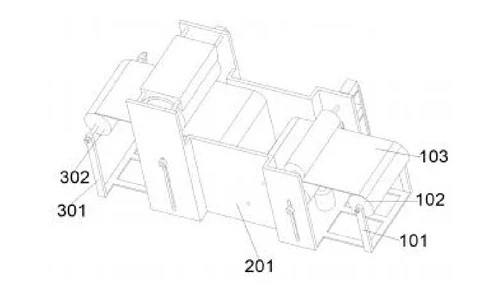
The light-pressing lower roller is welded to a light-pressing lifting frame, driven by the extension rod of a light-pressing lifting cylinder. The heavy-pressing lower roller has its own heavy-pressing lifting frame and heavy-pressing lifting cylinder. Two separate actuators mean the two gaps are set and held independently. Neither stage constrains the other.
Guided roller travel
Left and right guide grooves in the intermediate structure engage pulleys mounted on both sides of each pressing roller. The grooves constrain vertical travel to a single axis while the pulleys reduce sliding friction, so a commanded gap change produces the same actual gap change every time rather than binding and overshooting.
Inline heating roller
A heating cavity inside the metal heating roller carries an embedded heating pipe connected to an external supply. Heat is applied to the web itself in the roller train, not in a separate oven stage.
Continuous magnetic debris capture
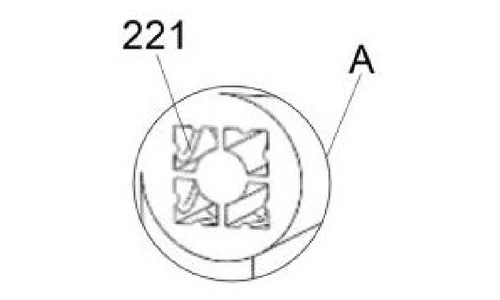
An electromagnet is mounted on a transverse frame above the heavy upper pressing roller. It adsorbs residual metal fragments and dust continuously during production.
This placement is deliberate. The heavy upper roller sits at the last nip the electrode passes, so any ferrous particle not removed before that point gets pressed into the finished electrode - where it becomes a potential internal short circuit in the assembled cell, not a cosmetic mark.
Drive
The motor frame carries four motors, driving the roller train.
Claimed Benefits
| Benefit | Mechanism responsible |
|---|---|
| Two selectable compaction thicknesses without changeover | Independent light- and heavy-pressure lifting cylinders |
| Target density reached at lower mechanical pressure | Inline heating roller raising material plasticity |
| Metal debris removed during production, no line stop | Electromagnet above the heavy upper pressing roller |
| Repeatable gap setting, reduced friction and binding | Guide grooves matched with roller-side pulleys |
| Compensation for tension-driven thickness variation | Stress roller plus two-stage independent pressure control |
How It Compares with Single-Pressure Roller Presses
The specification identifies three failures in the roller presses then in use: density could not be adjusted in production, metal debris built up on the rolls, and tension-driven variation disturbed the finished thickness. This patent answers each one inside a single machine.
| Dimension | Conventional approach | This patent design |
|---|---|---|
| Compaction stages | One fixed pressing stage per pass | Independent light- and heavy-pressure lifting cylinders, selectable without changeover |
| Density control | Higher mechanical pressure to reach target density | Inline heating roller raises material plasticity before the final nip |
| Debris handling | Removed only when the press is stopped | Electromagnet above the heavy upper roller captures debris continuously in production |
Where This Technology Is Used Today
This patent covers the mechanical architecture of TOB's production roller presses. The two-stage principle it protects - consolidate first, dimension second, with heat between - is how our calendering equipment holds electrode thickness across a full production roll.
- High Precision Electrode Rolling Press Machine for 4680 Tabless Battery - the two-stage compaction principle applied to tabless cell production
- Continuous Hydraulic Roller Heat Press Machine for Lithium Battery - inline heat ahead of the final nip on a continuous line
- Hydraulic Heating Calendering Machine for Battery Electrode - hydraulic pressing with heated rolls for electrode calendering
- Electrode Preparation - the mixing, coating and calendering line this press sits in
Related equipment enquiries: request a quote
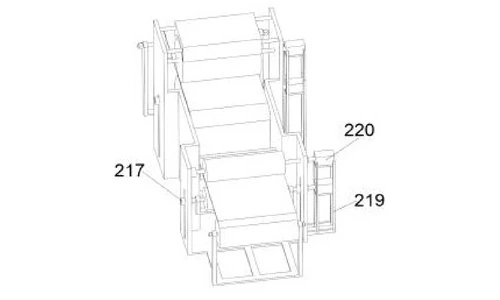
Patent Drawings
Frequently Asked Questions
What does patent CN215430810U cover?
It covers a lithium battery electrode roller press with two independently controlled pressing stages - a light-pressure roller pair and a heavy-pressure roller pair, each driven by its own lifting cylinder - together with an inline heating roller and an electromagnet that captures metal debris during operation.
Why use two pressing stages instead of one?
A single nip has to both consolidate the loose coating and set final thickness, and those two jobs need different pressures. Reaching final compaction density in one pass forces active material particles into excessive contact, which raises polarisation and reduces usable capacity. Two independently set stages let the electrode be consolidated first and dimensioned second.
Why does the press heat the electrode before the final nip?
Warming the electrode raises the plasticity of the coating material, so the target compaction density is reached at lower mechanical pressure. Heat substitutes for force, which is what keeps the process out of the over-compaction range that damages capacity.
How does the press remove metal debris without stopping?
An electromagnet mounted on a transverse frame above the heavy upper pressing roller continuously adsorbs metal fragments and dust while the line runs. Conventional presses must be halted for cleaning, which the specification identifies as a significant efficiency loss.
Why does metal contamination matter more than dust?
A ferrous particle pressed into an electrode at the final nip can become an internal short circuit in the finished cell. That is a safety defect rather than a surface blemish, which is why the design uses a magnet specifically rather than relying on suction alone.
Is patent CN215430810U still in force?
Yes. It is Active, filed 1 September 2021 with anticipated expiration on 1 September 2031, and has been cited by 2 subsequent patents.
Full specification and drawings: CN215430810U on Google Patents