Solid-State Battery Manufacturing Equipment Guide 2026–2027
Solid-State Battery Manufacturing: What Equipment Buyers Should Prepare for in 2026–2027
Solid-state battery announcements appear weekly. OEMs promise production timelines that shift quarter by quarter. Material companies claim breakthroughs in sulfide conductivity. Yet the manufacturing equipment supply chain—the actual machinery that turns powder into finished cells—remains the least discussed and most critical bottleneck.The transition from liquid-electrolyte lithium-ion to solid-state is not a modification. It is a replacement. A standard lithium-ion production line cannot be “upgraded” to solid-state. The dry room specifications, the electrode formation process, the stack assembly method, and the formation protocol all demand fundamentally different equipment.
For battery manufacturers preparing capex for 2026–2027, this guide identifies the four equipment areas where the specifications change, the current supplier landscape, and the cost implications that must be budgeted now.
The Equipment Break: What Changes from Li-Ion to Solid-State
A conventional lithium-ion line is built around liquid electrolyte. The solid-state line eliminates it. That single change cascades through every station.
| Manufacturing Step | Lithium-Ion (Liquid) | Solid-State | Equipment Impact |
| Electrode preparation | Wet slurry coating + drying | Dry mixing + calendering, or slurry coating + solvent removal | Solvent recovery systems eliminated; dry electrode lines added |
| Electrolyte application | Liquid filling under vacuum | Solid electrolyte layer deposition or lamination | Filling stations replaced by lamination or pressing stations |
| Cell assembly | Stacking/winding + electrolyte fill + sealing | Stacking under pressure + isostatic pressing + sealing | Hydraulic/Isostatic press added as bottleneck station |
| Dry room specification | Dew point -40°C | Dew point -60°C (sulfide), -50°C (oxide) | Entire HVAC system re-specified; capital cost 2–3× |
| Formation | SEI formation cycling at 25–45°C | Pressure-constrained cycling at 25–80°C | Formation fixtures must apply and maintain stack pressure |
A manufacturer with an existing lithium-ion line faces a choice: build a separate solid-state line or scrap and replace. There is no retrofit path that does not compromise both cost and performance.
1. Dry Room Infrastructure: The Spec That Surprises Every Buyer
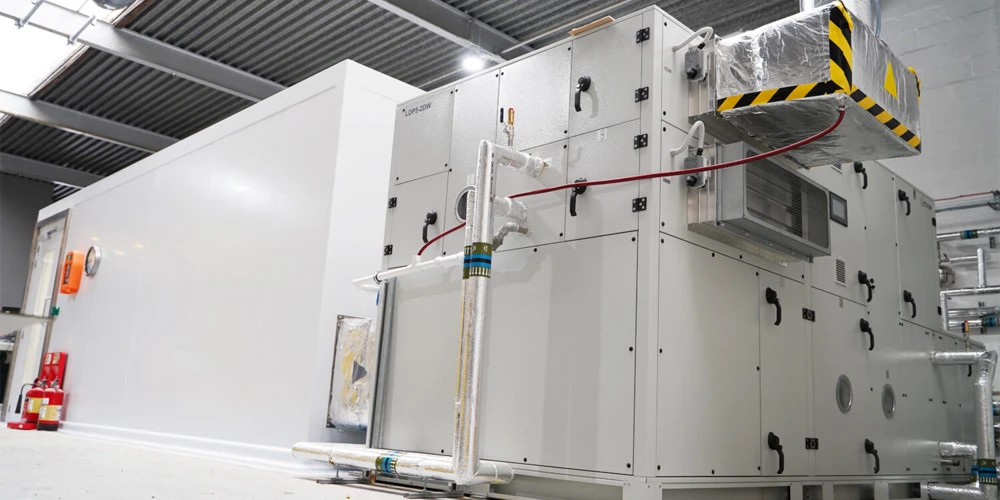
Sulfide solid electrolytes—the leading candidate for high-conductivity solid-state cells—react with moisture to produce hydrogen sulfide gas. Even at ppm levels, this reaction degrades the electrolyte and creates a toxicity hazard.
Dry room comparison:
| Parameter | Lithium-Ion Standard | Solid-State (Sulfide) | Solid-State (Oxide) |
| Dew point | -40°C | -60°C | -50°C |
| Moisture (H₂O) | < 1 ppm | < 0.01 ppm | < 0.1 ppm |
| Oxygen (O₂) | < 1 ppm | < 1 ppm | < 1 ppm |
| HVAC capital cost (1,000 m²) | $1.5–2.5M | $4.5–7.0M | $3.0–4.5M |
| Energy consumption (kWh/year) | 800–1,200 MWh | 2,500–3,500 MWh | 1,800–2,500 MWh |
The dew point specification is non-negotiable. Operating a sulfide solid-state line at -50°C dew point—only 10°C above the required -60°C—produces measurable H₂S within hours. Cells assembled under these conditions show capacity losses of 15–30% after 50 cycles compared to cells assembled under -60°C.
For procurement teams planning solid-state production, the dry room must be specified and budgeted before any process equipment. A solid-state battery dry room and dry atmosphere system supplier must demonstrate sustained -60°C dew point operation with real-time monitoring across the entire production floor, not just at sensor points near the air handlers.

2. Isostatic Pressing: The New Bottleneck Station
Solid-state cells require intimate solid-solid contact between electrolyte particles and electrode active material. This contact is achieved through high-pressure isostatic pressing—not the light calendering used for liquid-electrolyte electrodes.
Isostatic pressing specifications:
| Parameter | Cold Isostatic Press (CIP) | Warm Isostatic Press (WIP) |
| Pressure range | 200–600 MPa | 100–400 MPa |
| Temperature range | Ambient | 40–150°C |
| Cycle time (per cell stack) | 2–5 minutes | 5–15 minutes |
| Equipment cost per station | $200,000–350,000 | $300,000–500,000 |
| Throughput (cells per hour, single station) | 12–30 | 4–12 |
For a 100 MWh/year solid-state line producing 20 Ah pouch cells, approximately 4–6 isostatic pressing stations are required. The pressing station becomes the line’s throughput constraint. Unlike liquid-electrolyte filling, which can be parallelized easily, isostatic pressing vessels are high-pressure systems that scale in cost non-linearly with vessel size.
The pressing parameter must be matched to the solid electrolyte material. Oxide electrolytes (LLZO, LATP) require higher pressures (300–500 MPa) and benefit from warm pressing to improve particle deformation. Sulfide electrolytes (LGPS, argyrodite) can be pressed at lower pressures (150–250 MPa) but are more sensitive to moisture exposure during handling between pressing and sealing.
solid-state battery isostatic pressing machine supplier should provide pressure uniformity mapping across the full vessel volume, with demonstrated ±5 MPa uniformity at working pressure.
3. Dry Electrode Processing: The Enabler for Solid-State Cathodes
The solid-state cell architecture eliminates liquid electrolyte but not the cathode composite. The cathode still requires active material, solid electrolyte, conductive carbon, and binder—mixed and formed into a dense electrode film.
Two process paths are under development:
| Process | Description | Equipment Required | TRL (2026) |
| Dry mixing + hot calendering | Dry powder mixed with PTFE binder, fibrillated, and calendered into free-standing film | High-shear mixer, fibrillation unit, heated calender | 6–7 (pilot-scale proven, scaling to mass production) |
| Slurry coating + binder burnout + sintering | Slurry coated onto current collector, dried, binder removed thermally, and sintered (oxide electrolyte) | Coating line, high-temperature furnace (700–1,200°C) | 4–5 (demonstrated for oxide electrolytes at lab scale) |
For sulfide-based solid-state cells, the dry mixing and calendering route is currently the leading manufacturing approach. It avoids solvent entirely, which is critical because sulfide electrolytes react with most polar solvents.
The equipment for dry electrode processing differs from conventional wet coating in three critical ways:
- Mixing: High-shear dry mixing is required to distribute solid electrolyte particles uniformly through the cathode composite. Inhomogeneity at the micron scale creates localized ionic resistance.
- Calendering: The dry electrode film must be calendered directly onto the current collector or onto the solid electrolyte separator layer. Calendering pressure, roll temperature, and speed must be controlled to ±2% to achieve target porosity.
- Lamination: The cathode composite, solid electrolyte separator layer, and anode (typically lithium metal or graphite) must be laminated together under controlled pressure and temperature.
4. Lithium Metal Anode Handling: The Safety Specification Upgrade
Solid-state cells using lithium metal anodes introduce a manufacturing hazard that liquid-electrolyte graphite-anode lines do not face. Lithium metal is reactive, ductile, and difficult to handle in thin foils.
Lithium metal anode processing requirements:
| Parameter | Specification |
| Lithium foil thickness | 10–50 μm (target <20 μm for high energy density) |
| Handling atmosphere | Argon, H₂O < 0.1 ppm, O₂ < 0.1 ppm |
| Foil tension control | < 0.5 N across 200 mm web width |
| Lamination pressure | 1–5 MPa, uniform to ±0.2 MPa |
| Defect detection | In-line optical inspection for pinholes, thickness variation, and surface contamination |
Lithium metal foil is mechanically fragile. Standard roll-to-roll handling equipment designed for copper and aluminum current collectors cannot process 20 μm lithium foil without tearing or wrinkling. Specialized tension control and web handling systems are required.
For the anode-to-solid-electrolyte lamination step, pressure must be sufficient to ensure intimate contact but not so high as to extrude lithium into the solid electrolyte layer, creating a potential short-circuit path.
Supplier Readiness Assessment for 2026–2027
The solid-state battery equipment supply chain is nascent compared to the mature lithium-ion equipment industry. Procurement teams must assess supplier readiness against demonstrated capability, not marketing claims.
| Equipment Category | Supplier Maturity | Lead Time Estimate (2026) | Key Evaluation Criteria |
| Dry rooms (-60°C dew point) | Moderate; few qualified integrators | 10–14 months | Sustained dew point under production conditions, not just at commissioning |
| Isostatic presses | Low; specialized hydraulic system suppliers | 12–16 months | Pressure uniformity mapping; cycle time under production conditions |
| Dry electrode lines | Low; pilot-scale demonstrated, scaling up | 12–18 months | Web width capability; demonstrated film uniformity data |
| Lithium metal handling | Very low; custom engineering required | 14–20 months | Thin-foil tension control; defect detection capability |
| Assembly and sealing | Moderate; adapted from Li-ion with upgrades | 8–12 months | Atmosphere compatibility; pressure-constrained sealing |
Procurement Insight: The solid-state equipment supply chain is not yet competitive. Most suppliers have one or two pilot installations, not a track record of mass production equipment delivery. Procurement teams should prioritize suppliers with demonstrated lithium-ion production line experience and an active solid-state R&D program. A solid-state battery production line turnkey manufacturer with both lithium-ion and solid-state equipment capability provides continuity of support across technology transitions.
Cost Estimate: Solid-State Pilot Line vs. Mass Production Line
| Line Scale | Capacity | Equipment Capital Cost (2026–2027 Est.) | Key Cost Drivers |
| R&D pilot line | 1–5 MWh/year | $5–10M | Dry room, isostatic press, glovebox-scale assembly |
| Pilot production line | 50–100 MWh/year | $30–60M | Dry room, multiple isostatic presses, dry electrode line, lithium metal handling |
| Mass production line (target) | 1 GWh/year | $180–350M | Dry room scaling, high-throughput pressing and lamination, automated material handling under argon |
These estimates represent 2–3× the cost of equivalent-capacity lithium-ion lines. The premium is driven by the ultra-dry atmosphere requirements and the cost of isostatic pressing and lithium metal handling equipment.
Frequently Asked Questions (FAQ)
Q: Can a standard lithium-ion dry room be upgraded for sulfide solid-state production?
A: No. The -60°C dew point requirement demands fundamentally different desiccant wheel systems, lower air leakage rates, and more extensive vapor barriers. Retrofitting a -40°C dry room to -60°C typically costs more than building new, and performance guarantees are difficult to obtain.
Q: What is the single most expensive piece of solid-state battery manufacturing equipment?
A: The isostatic pressing station for oxide electrolyte cells, at $300,000–500,000 per station. For sulfide cells, the dry room HVAC system is typically the largest single capital item.
Q: When will solid-state battery production equipment be available at competitive lead times?
A: Not before 2028–2029, based on current equipment supplier development timelines. The 2026–2027 period is for pilot and early production lines with lead times of 12–20 months for critical equipment.
Q: Are dry electrode lines required for solid-state, or can wet coating still be used?
A: Wet coating is being developed for oxide solid electrolytes, where the material can tolerate certain solvents and a high-temperature sintering step. For sulfides, dry processing is currently the only viable route because sulfides react with virtually all coating solvents.
Ready to Plan Your Solid-State Production Line?
Solid-state battery manufacturing is an equipment challenge as much as a materials challenge. The four critical subsystems—ultra-dry atmosphere, isostatic pressing, dry electrode processing, and lithium metal handling—must be specified, sourced, and integrated by a single engineering team with demonstrated experience in both lithium-ion and solid-state production.
TOB New Energy supplies pilot and production-scale solid-state battery equipment from its source factory in Xiamen, China. Equipment is designed for the specific requirements of sulfide and oxide solid electrolytes, with atmosphere control, pressure uniformity, and material compatibility engineered from first principles. Request solid-state equipment specifications, line layouts, and preliminary project quotations.
This technical guide was prepared by the process engineering team at TOB New Energy, a direct manufacturer of lithium-ion and solid-state battery production equipment. All specifications are based on demonstrated pilot installations and ongoing solid-state manufacturing R&D programs.